
Peregrine falcon facts for kids
Quick facts for kids Peregrine falcon |
|
|---|---|
 |
|
| Male in Toronto, Ontario | |
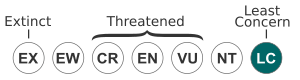
| Conservation status | |
Scientific classification  |
|
| Kingdom: | Animalia |
| Phylum: | Chordata |
| Class: | Aves |
| Order: | Falconiformes |
| Family: | Falconidae |
| Genus: | Falco |
| Species: |
F. peregrinus
|
| Binomial name | |
| Falco peregrinus Tunstall, 1771
|
|
| Subspecies | |
|
18–19, see text |
|
 |
|
| Global range of F. peregrinus
Breeding summer visitor Breeding resident Winter visitor Passage visitor |
|
| Script error: The function "autoWithCaption" does not exist. | |
| Synonyms | |
|
|
Script error: No such module "Check for conflicting parameters".
The peregrine falcon (Falco peregrinus) is a famous bird of prey known worldwide as a master flier. It belongs to the family Falconidae and is roughly the size of a crow. It has a sleek blue-grey back, barred white belly, and a dark hood on its head. As an bird-hunting predator, the female is much larger than the male. In science, this size difference is called sexual dimorphism. Long ago, people called it the "black-cheeked falcon" in Australia or the "duck hawk" in North America.
This wild hunter lives almost everywhere across our globe. It makes its home from the chilly Arctic tundra all the way to warm tropics. You can find it on every continent except Antarctica. It only avoids high frozen mountain peaks and deep rainforests. Because it is missing naturally from New Zealand, it is still the world's most widespread hunting bird. The only bird that covers more land is the domestic and feral pigeon, which humans carried everywhere. Pigeons descended from the wild rock dove and provide a plentiful food supply for falcons in every modern city.
Peregrine falcons thrive around humans as part of our amazing urban wildlife. They use skyscraper ledges like natural mountain cliffs and feast on abundant city pigeons. Both their English name and their scientific name mean "wandering falcon" because northern birds travel long paths during seasonal migration. Scientists recognize 18 or 19 different types, known as subspecies, across the world. For many years, researchers debated whether the desert-dwelling Barbary falcon was a separate species, but genetic tests show they separated recently during the Last Ice Age.
This raptor mainly eats other birds in mid-air, though it occasionally takes small mammals or reptiles. When it is one year old, it finds a partner and mates for life. Instead of building a messy twig nest, it lays eggs in a simple scraped hollow called a scrape. Decades ago, human poisons like DDT nearly caused these birds to vanish forever. Thanks to strict laws and captive breeding, wild populations recovered completely. Falcon lovers also admire them in ancient falconry, training them to hunt game birds.
Contents
How to Identify the Peregrine Falcon

A full-grown peregrine falcon measures between 34 to 58 cm (13–23 in) long from beak to tail. Its wings stretch out from 74 to 120 cm (29–47 in) across. Both male and female birds share identical feather colours and body patterns. However, just like other birds of prey, the female weighs up to 30% more than the male. Male falcons weigh between 330 to 1,000 g (12–35 oz). Females are much heavier, weighing from 700 to 1,500 g (25–53 oz).
Scientists take exact measurements of wild birds to identify them accurately. The length of the folded wing, called the wing chord, measures 26.5 to 39 cm (10.4–15.4 in). Their tail reaches 13 to 19 cm (5.1–7.5 in), while the lower leg bone, or tarsus, measures 4.5 to 5.6 cm (1.8–2.2 in).
Feathers, Wings, and Colors

Adult peregrines show off long, sharply pointed wings that look like curved sickles. Their upper plumage ranges from slate grey to bluish-black with subtle dark bands. Underneath, their belly feathers are white or pale buff with neat dark bars. The tail ends in a rounded tip bordered with black and white.
Young falcons look much browner than their parents. Instead of neat horizontal bars across their chests, immature falcons show vertical brown streaks.
Specialized Head and Beak Features
The falcon's head features a distinctive dark hood with a bold black mustache mark. The bare, fleshy skin around its nostrils, known as the cere, glows bright yellow. Its sharp curved talons and hooked beak are blue-black.
A unique physical adaptation appears near the tip of the upper beak. This sharp projection, called the tomial tooth, snaps the neck bones of prey instantly. The dark patch beneath each eye acts like built-in sports paint. It absorbs bright sunlight and cuts down blinding glare during fast chases.
Scientific History and Classification
The English naturalist Marmaduke Tunstall wrote the first official description of the bird in 1771. He assigned it the scientific binomial name Falco peregrinus. The phrase came from Medieval Latin words used by Albertus Magnus back in the year 1225. Tunstall picked this label because young birds were captured while traveling on migration journeys. The word falco traces back to an ancient Latin root describing a sickle blade.
Peregrine falcons belong to an ancient bird family alongside desert-hunting hierofalcons and the North American prairie falcon. Experts believe these hunting birds split from earlier ancestors between 3 and 8 million years ago during the Late Miocene or Late Pliocene. Because related species live in both the Old World and the Americas, their original ancestor probably came from Africa or Eurasia. Family trees get complicated because different wild falcon species occasionally create a natural hybrid, blending their mtDNA genes over generations. In Central Asia, the large saker falcon shares ancient genetic markers from female peregrine ancestors.
Global Subspecies Across the World


Scientists have documented around 19 recognized regional forms called subspecies in major ornithological handbooks like the Handbook of the Birds of the World. Each local type shows special variations in size, chest patterns, and feather darkness:
- Falco peregrinus anatum: Named by Bonaparte in 1838, this famous American peregrine lives along the Rocky Mountains. Decades ago, it suffered a sad local extinction in eastern forests, but human breeding programs returned it safely to wild cliffs. Males weigh 500 to 700 g (1.1–1.5 lb), while large females weigh up to 1,100 g (2.4 lb).
- Falco peregrinus babylonicus: Discovered by P.L. Sclater in 1861, this pale falcon lives in Iran, the Hindu Kush, and rugged cliffs across the Tian Shan and Mongolian Altai mountains. It resembles a small, sandy lanner falcon.
- Falco peregrinus brookei: Known as the Mediterranean peregrine, Sharpe named it in 1873. It hunts cliffs across the sunny Iberian Peninsula and eastward toward the rugged Caucasus mountains, staying resident all year without migrating.
- Falco peregrinus calidus: Described by John Latham in 1790, this cold-weather bird breeds across the vast Arctic tundra of Murmansk Oblast and Siberian rivers like the Yana and Indigirka River. It completes epic flights south into South Asia and warm regions of sub-Saharan Africa.
- Falco peregrinus cassini: Named in 1873 by Sharpe, this bird nests along the southern Andes from Ecuador to the Falklands. A rare pale color form called the pallid falcon shows light feathers similar to a saker falcon.
- Falco peregrinus ernesti: Found across tropical rainforest islands from the Sunda Islands to New Guinea and the Bismarck Archipelago, this dark hunter displays almost solid black cheek marks.
- Falco peregrinus furuitii: A very rare island form identified by Momiyama in 1927, living quietly on rocky outcrops of the Izu Islands and Ogasawara Islands south of Japan's main island of Honshū.
- Falco peregrinus japonensis: Named by Gmelin in 1788, this northern bird ranges across Siberia and Kamchatka down into the Japanese archipelago.
- Falco peregrinus macropus: Known as the black-cheeked falcon, Swainson described it in 1837 across most Australian territories. It has very large feet for gripping fast parrots.
- Falco peregrinus madens: Discovered by Ripley and Watson in 1963 in the Cape Verde Islands, this critically rare island hunter displays warm reddish feathers on its neck.

- Falco peregrinus minor: Identified by Bonaparte in 1850, this tiny, dark-feathered bird lives throughout Southern Africa and ranges north to Morocco. Small males weigh barely 300 g (11 oz).
- Falco peregrinus nesiotes: Named by Mayr in 1941, this non-migratory raptor hunts across the South Pacific islands of Fiji, Vanuatu, and New Caledonia.
- Falco peregrinus pealei: Known as Peale's falcon, Ridgway described it in 1873 along rainy coasts of the Pacific Northwest, Puget Sound, Haida Gwaii, the Gulf of Alaska, and the misty Aleutian Islands. It is the largest of all peregrine falcons, with females reaching 1,500 g (3.3 lb).
- Falco peregrinus pelegrinoides: Identified by Temminck in 1829, this pale, desert-adapted hunter lives from the Canary Islands across North Africa and the Near East.
- Falco peregrinus peregrinator: Named by Sundevall in 1837, the beautiful shaheen falcon lives across the Indian subcontinent, rocky parts of Tibet, and tropical hills of Sri Lanka.
- Falco peregrinus peregrinus: The original European form named by Marmaduke Tunstall in 1771 breeds from temperate woods to the high peaks of the Pyrenees and the Alpide belt.
- Falco peregrinus radama: Found exclusively on Madagascar and the nearby Comoros islands, this non-migratory form was named by Hartlaub in 1861.
- Falco peregrinus submelanogenys: Described in 1912 by Mathews, this dark-cheeked falcon lives in the forests of the Southwest Australian corner.
- Falco peregrinus tundrius: Described in 1968, this small, pale bird nests on high tundra rocks from northern North America to Greenland. It undertakes massive migrations every autumn into South America, though some turn up as lost vagrants in western Europe.
The Unique Barbary Falcon

The pale Barbary falcon lives in dry, sun-drenched habitats across North Africa and the Canary Islands. It has a slimmer body, a rusty neck patch, and lighter belly bars. Scientists noticed its pale colors follow Gloger's rule, a biological pattern where animals in dry sunny lands evolve lighter skin or feathers than relatives in damp climates.
These birds fly with shallow, fast wingbeats, fluttering like ocean fulmars. They rely on rugged cliffs far from human noise. On the island of Tenerife, breeding pairs live spaced several kilometers apart. Because local birds face threats from illegal capture, biologists work hard to protect their nesting cliffs.
How the Peregrine Falcon Survives in the Wild


Peregrine falcons occupy many natural habitats. They hunt along rugged mountain ranges, wide river valleys, and wild coastlines. Many populations have moved right into busy modern cities. Falcons living in warm climates stay in the same nesting territory all year. Northern birds nesting in freezing Arctic lands travel thousands of miles during autumn to avoid harsh blizzards.
To survive extreme diving speeds, their bodies have built-in safety gear. Inside each nostril sits a tiny cone of bone called a tubercle. Scientists believe these small baffles slow down rushing air, protecting the bird's fragile lungs from high air pressure during deep dives.
Their eyes have remarkable protective features too. Falcons use clear third eyelids, called nictitating membranes, to wipe away dust and spread tears while diving. This lets the bird see clearly without closing its main eyelids. Their eyes also process motion at an astonishing rate. Their visual processing speed, known as flicker fusion threshold, reaches 129 cycles per second. This is far faster than human eyes, allowing them to track darting targets easily.
In the wild, healthy falcons can survive up to 19 years. Life is dangerous for young fledglings, and between 59% and 70% do not survive their first challenging year. Outside of accidental collisions with man-made towers or cables, falcons must watch out for larger hawks and giant hunting owls.
Wild falcons also host microscopic parasites and illness-causing germs. They can catch bird viruses like Avipoxvirus, Newcastle disease virus, or Falconid herpesvirus 1. Blood parasites such as Plasmodium relictum, flatworm trematodes, roundworms, and tapeworms occasionally live inside their digestive tracts. Tiny external pests like chewing lice, bird fleas, and flat louse flies hide between their feathers.
The Fastest Hunter in the Sky
The peregrine falcon holds the world record as the fastest animal alive. When cruising level through the air, it flaps its wings at normal bird speeds. But when it spots prey far below, it folds its wings tight against its body and enters an incredible vertical power-dive called a stoop.
During a steep stoop, gravity and sleek aerodynamics pull the bird downward at blinding speeds. Computer flight models show an ideal falcon could theoretically dive at 400 km/h (250 mph) near sea level. In 2005, a skydiver and falcon researcher named Ken Franklin recorded a trained falcon diving at 389 km/h (242 mph) using a tiny digital altimeter. Other radar tracking devices have officially clocked wild hunting dives at 184 km/h (114 mph). This breathtaking velocity gives the hunter unmatched momentum to strike dodging prey.
Hunting Strategy and Diet

The peregrine falcon is an extraordinary bird hunter. Across the world, scientists have documented peregrines catching between 1,500 and 2,000 different species of birds. In North America alone, they hunt over 300 bird species, including nearly 100 kinds of shorebirds. Their prey ranges in size from tiny 3 g (0.11 oz) hummingbirds all the way up to huge 3.1 kg (6.8 lb) sandhill cranes.
Most hunting targets are medium-sized birds weighing between 20 g (0.71 oz) and 1,100 g (2.4 lb). Common targets include plump pigeons, migratory waterfowl, wild gamebirds, energetic songbirds, colorful parrots, and coastal seabirds. They regularly catch ducks, geese, diving loons, wetland rails, screeching gulls, heavy capercaillies, and mountain ptarmigans. They also target smaller raptors like sharp-shinned hawks, owls, and small falcons such as the American kestrel and the swift merlin.
In modern cities, pigeons form the vast majority of their daily meals. A hungry city falcon feeds heavily on the rock dove or feral pigeon, which makes up over 80% of its diet. They also catch mourning doves, wild wood pigeons, fast common swifts, tree-climbing northern flickers, and collared doves. Other common city victims include noisy starlings, garden robins, blackbirds, and intelligent corvids like magpies, blue jays, and sharp-eyed crows. Along wild northwestern beaches, large Peale's falcons feed almost completely on nesting seabirds, while wintering Arctic birds in South America have been seen catching colorful young scarlet ibises.
Peregrine falcons also capture other kinds of animals when birds are scarce:
- Flying bats, which they ambush at twilight or under bright city lights.
- Small rodents like collared lemmings and tundra ground squirrels in northern regions.
- Little mammals such as shrews, wild mice, rats, meadow voles, and tree squirrels.
- Young cottontail rabbits and baby hares.
- Tiny reptiles, including small garden snakes and fast lizards.
- Flying insects and even leaping salmonid fish snatched from the water surface.
Falcons prefer to hunt at dawn and dusk when flocking birds are flying. They scan open terrain like wide marshes, flat river valleys, farm fields, and open tundra. Once a falcon spots a target, it tips forward into its blazing dive. It strikes the flying victim with a tightly clenched foot, stunning or killing it instantly in mid-air. The falcon loops around, catches the falling bird in its talons, and carries it off to a high rock to pluck the feathers clean before eating.
Reproduction and Raising Chicks


Peregrine falcons become mature enough to raise families when they are between one and three years old. Once two falcons choose each other, they pair up for life. Every spring, the couple returns to the exact same cliff territory. During their romantic courtship, the male and female perform stunning acrobatic displays in the sky, tumbling together and tracing spirals through the clouds. In a thrilling mid-air food pass, the male flies carrying a fresh catch, and the female rolls completely upside-down beneath him to grab the prize from his talons.
Pairs guard their nesting homes fiercely. Nests are spaced more than a kilometer apart so every family has enough hunting room. The female chooses a high cliff ledge sheltered by an overhanging rock. She does not carry sticks or moss; instead, she scrapes out a shallow bowl in loose dirt or gravel with her feet. In wild forests, falcons occasionally use large tree hollows, and in big cities, they adopt skyscraper balconies and bridge towers.
A mated pair will boldly attack dangerous trespassers near the nest ledge. They divebomb annoying ravens and large eagles that drift too close. When larger raptors like great horned owls or eagle-owls sneak up at night, they pose serious danger to sleeping chicks. By day, however, parent falcons have knocked down huge predators, including golden eagles, mighty bald eagles, and even snowy owls by striking them with full-speed stoops.
The female lays three or four mottled cream-and-brown eggs during early spring. Both parents take turns warming the eggs for around a month, though the mother sits on the nest throughout every chilly night. When the chicks, called eyases, hatch from their shells, they are covered in soft white down and have comically large feet. Both parents work tirelessly, flying up to 24 kilometers on hunting trips to feed their hungry young. Within six weeks, the chicks grow strong flight feathers, learn to fledge, and spend another two months practicing high-speed hunting moves with their parents.
Relationship with Humans
Human beings have held the peregrine falcon in high regard for thousands of years. Nomadic peoples in central Asia first tamed these birds for hunting more than 3,000 years ago. In ancient falconry, the male bird was called a tiercel, while the larger female was simply called the falcon. Nobles admired the peregrine because it was calm, intelligent, easy to train, and bold enough to hunt large quarry.
Falconers also discovered that trained birds could protect commercial aircraft. By flying peregrines around busy airport runways, handlers scare away flocks of wandering gulls and geese, preventing dangerous mid-air collisions.
The DDT Crisis and Eggshell Thinning
During the 1950s and 1960s, farmers began spraying large amounts of synthetic chemicals like organochlorines, especially DDT, on crops to kill insect pests. These poisons did not break down easily in the soil. Instead, they passed up the food chain from insects to songbirds, building up in higher amounts in top predators through a process called biomagnification.
Inside female peregrines, the built-in chemicals disrupted how their bodies handled calcium. When mother birds laid their eggs, the shells were terribly thin and fragile. When parents tried to sit gently on the nest to keep the eggs warm, the brittle shells cracked under their weight, destroying the embryos. In eastern North America and parts of Europe, peregrine populations crashed completely, leaving historic cliff nests silent and empty.
How Conservationists Saved the Species
To rescue the magnificent bird from vanishing, governments took bold action. In the early 1970s, countries banned the use of harmful DDT sprays. Dedicated wildlife scientists formed recovery teams and began breeding falcons in safe captivity.
Biologists developed clever techniques to raise healthy wild chicks. Keepers fed newly hatched babies using a lifelike bird hand puppet so the young falcons would not identify humans as parents, a mistake known as human imprinting. When the chicks grew strong, caretakers placed them in cliff boxes and quietly left food while the youngsters practiced flying. This gentle release method, known as hacking, taught captive-bred falcons how to hunt on their own before full release.
Thanks to conservation groups like The Peregrine Fund, thousands of healthy young falcons were set free across mountain ranges and urban skylines. The recovery succeeded beyond expectations. On August 25, 1999, the United States officially took the peregrine falcon off the federal Endangered Species list.
Thriving in Modern Urban Skies
Today, peregrines are doing remarkably well in countries all around the world. In the United Kingdom, teams from the Royal Society for the Protection of Birds help protect hundreds of wild nesting pairs. In Canada, wildlife experts removed the bird from their national risk list after healthy populations expanded across the north.
Skyscrapers and tall suspension bridges provide ideal urban homes for peregrines. The sheer concrete walls mimic natural mountain cliffs, keeping nests safe from ground predators. Bright city lights allow falcons to hunt late into the evening, catching night-flying migrants like redwings, spotted fieldfares, and camouflaged woodcocks. Urban wildlife webcams now allow millions of school children and bird watchers to watch peregrine parents feed their chicks on downtown rooftops every spring.
Falcons in Art, Symbols, and Culture
Across history, powerful civilizations chose the peregrine falcon as an emblem of bravery and noble speed. In ancient Egyptian religion, people honored the sun god Ra, frequently showing him with the head of a hooded falcon. Early Native American artists of the ancient Mississippian culture carved sacred stone statues and copper plates depicting falcon dancers to celebrate sky power.
In European history, royal courts considered the peregrine a bird fit for royalty and princes. In the United States, the falcon appears stamped on the official 2007 Idaho state quarter, and the city of Chicago adopted it as its official municipal bird. Writers and filmmakers celebrate the raptor too; the classic English nature book The Peregrine, written by J. A. Baker, describes the bird's thrilling life through winter skies. In engineering, Japanese vehicle designers named the record-breaking Suzuki Hayabusa motorcycle after the falcon, honoring the fastest animal on the planet.
See also
 In Spanish: Halcón peregrino para niños
- List of birds by flight speed
- Perilanner, a hybrid of the peregrine falcon and the lanner falcon (Falco biarmicus)
- Perlin, a hybrid of the peregrine falcon and the merlin (Falco columbarius)
